
Commercial Door Hinge Sizes: A Spec Guide for Contractors
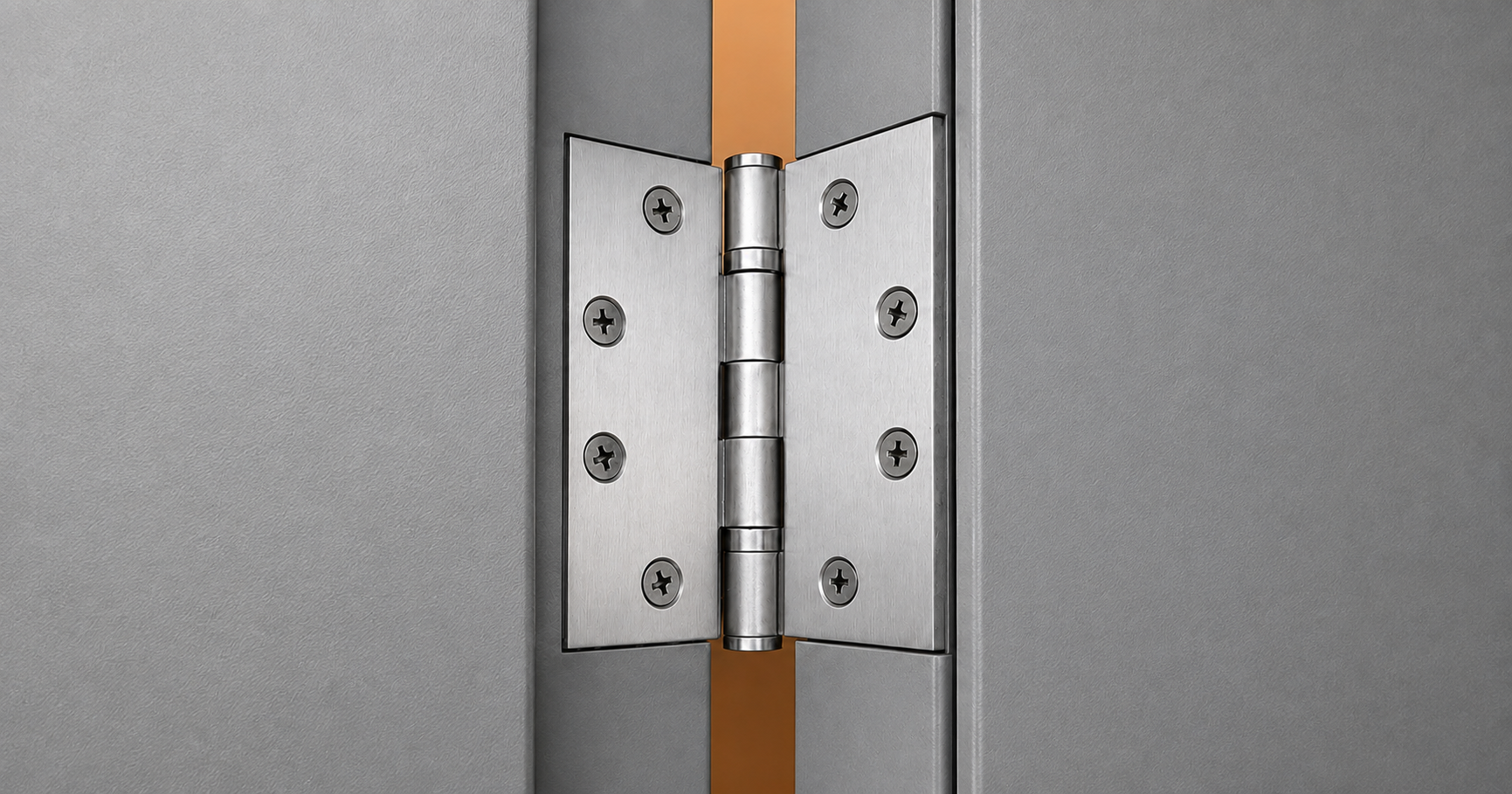
Commercial door hinge sizes are the smallest line on a hardware schedule and one of the most expensive to get wrong. A hinge that’s a half-inch short, a grade too light, or two-to-a-leaf on a door that needed three doesn’t fail on install day. It fails eighteen months later, when the top hinge has pulled, the leaf has dropped, and the door drags the frame every time someone opens it. By then it’s a callback, not a line item.
Five decisions make up a hinge spec: size, quantity, weight, bearing type and finish. Get all five right and the opening outlasts the building’s first two tenants. This guide walks each one, with the charts you actually need at the desk.
How commercial door hinge sizes are written
A hinge size is always height × width, height first. A “4-1/2 × 4-1/2” hinge is four and a half inches tall and four and a half inches wide. That sounds obvious until you see a schedule that reads “5 × 4-1/2” and someone orders a 4-1/2 × 5 instead. They are not the same hinge and they do not fit the same prep.
Height is measured along the barrel, parallel to the pin — the dimension that has to match the mortise cut into the door edge and the frame jamb. Width is measured across both leaves with the hinge opened flat, not folded. It governs how far the door stands off the jamb when it swings.
Hinge height: door thickness and width decide it
Height is the first number to pin down, and it follows from two things about the door: how thick it is, and how wide. Thicker and wider means heavier, and heavier means a taller hinge to spread the load over more of the door edge. The chart below is standard industry practice and covers the full range of door types you’ll meet, from light residential leaves up to heavy 2-1/2” doors.
| Door thickness | Door width | Hinge height |
|---|---|---|
| 3/4” – 1-1/8” | To 36” | 3” |
| 1-3/8” | To 32” | 3-1/2” |
| 1-3/8” | Over 32” to 37” | 4” |
| 1-3/4” | To 36” | 4-1/2” |
| 1-3/4” | Over 36” to 48” | 5” |
| 2”, 2-1/4”, 2-1/2” | To 42” | 5” heavy weight |
| 2”, 2-1/4”, 2-1/2” | Over 42” to 48” | 6” heavy weight |
Standard practice chart. Confirm against the door manufacturer’s template and the hardware schedule on rated or heavy openings.
On commercial work the row that matters most is the fourth one. Hollow metal doors are 1-3/4” thick as a matter of course, and the most common commercial leaf is 3’0” wide — 36”. That lands squarely on 4-1/2” × 4-1/2”, which is why that size is the default across nearly every commercial hardware set. Widen the leaf past 36” and you step up to a 5” hinge. If you’re not sure which leaf width you’re dealing with, our guide to hollow metal door sizes and rough openings covers the standard grid.
Hinge width: standard, narrow and wide throw
For most openings, width follows height and you don’t think about it. A 4-1/2” hinge is 4-1/2” wide, a square hinge, and the door clears the jamb fine. Width only becomes a decision in two situations.
Narrow width — a 4-1/2” × 4” hinge, for example — is used on storefront and narrow-stile applications where there simply isn’t leaf room for a full square hinge. Wide throw goes the other way: when the door has to swing clear of projecting trim, a deep reveal, or a wall it would otherwise hit at 180°, you spec a hinge wider than standard to push the door further off the jamb.
Round up to the next available hinge width. If the result is at or under the standard square width, a standard hinge is fine.
| Hinge size | Profile | Typical use |
|---|---|---|
| 4-1/2” × 4” | Narrow | Storefront, narrow-stile leaves |
| 4-1/2” × 4-1/2” | Square, standard | 1-3/4” commercial door to 36” wide |
| 4-1/2” × 5” | Wide throw | Clearing projecting trim or a deep reveal |
| 5” × 4-1/2” | Tall, standard width | Leaves over 36” wide, heavy doors |
Also worth noting: a square hinge is reversible, so one part number covers both hands. That is not true once you get into wide throw or handed designs, where the door handing has to be right on the order. If handing is in question, work it out on the door handing chart before the order goes in.
How many hinges per door
Quantity is set by door height, and the rule is easy to remember: two hinges to five feet, then one more for every additional thirty inches of height.
| Door height | Hinges per leaf | Common example |
|---|---|---|
| Up to 60” | 2 | Cabinet and utility doors |
| Over 60” to 90” | 3 | 6’8” and 7’0” commercial doors |
| Over 90” to 120” | 4 | 8’0” and 9’0” openings |
| Over 120” to 150” | 5 | Oversized and monumental leaves |
In practice, almost every standard commercial door lands on three hinges per leaf. A 6’8” door is 80” and a 7’0” door is 84”; both sit inside the 60”–90” band. Step up to an 8’0” door at 96” and you need four.
Two more quantity notes. First, high-frequency openings — a main entrance, a stairwell door on a busy floor — are worth a fourth hinge even where three would satisfy the rule, because the extra hinge distributes cycle wear rather than concentrating it. Second, a door with a closer on it works harder than one without, which pushes you toward heavier hinges as well as more of them.
Standard weight vs. heavy weight
Two hinges can be the same size and still be very different products. Weight class is set by leaf gauge — how thick the steel of the leaf actually is — and it is what determines whether the hinge holds up under a heavy door, a closer, or high traffic.
| Leaf gauge | Class | Where it belongs |
|---|---|---|
| 0.134” (3.4 mm) | Standard weight | Medium-weight doors, normal traffic |
| 0.180” (4.6 mm) | Heavy weight | Heavy doors, closers, high traffic |
| 0.190” (4.8 mm) | Heavy weight, 5” | Oversized and high-abuse openings |
The practical test: go heavy weight if the door is over 200 lbs, if it carries a closer, if it’s an exterior or high-traffic opening, or if it’s wider than 36”. Everything else is comfortable on standard weight. When in doubt, heavy weight costs a little more per hinge and removes an entire category of failure — it is the cheapest insurance on the schedule.
Plain bearing vs. ball bearing
Bearing type governs how the hinge handles friction over hundreds of thousands of cycles. It is the difference between a hinge that squeaks and binds after a few years and one that swings the same at year fifteen.
- Knuckles ride directly on one another — no bearing races
- Lower cost, suited to lighter doors and low cycle counts
- Not recommended under a door closer
- Interior, low-traffic openings
- Sealed bearings between knuckles carry the load
- Far higher cycle life, stays quiet and smooth
- Required in practice wherever a closer is fitted
- Exterior, fire-rated and high-traffic openings
On commercial work the answer is nearly always ball bearing. A plain bearing hinge under a closer is a warranty claim waiting to happen: the closer drives the door shut on every cycle, and without bearings that force goes straight into knuckle wear. The extra cost of ball bearing is small next to a service call.
ANSI/BHMA grades and what the cycle numbers mean
ANSI/BHMA A156.1 is the standard that grades butt hinges, and the grade is a cycle-life rating from a controlled test — a hinge is cycled until it fails or reaches the count. It is the only apples-to-apples number in the category.
| Grade | Cycle rating | Intended service |
|---|---|---|
| Grade 1 | 2,500,000 cycles | Heavy duty — entrances, stairwells, high traffic |
| Grade 2 | 1,500,000 cycles | Standard duty — general commercial |
| Grade 3 | 350,000 cycles | Light duty — low-traffic interior |
Those numbers look abstract until you convert them. A door opened 200 times a day runs about 73,000 cycles a year. A Grade 3 hinge is spent in under five years on that opening. A Grade 1 hinge is still inside its rating after thirty. That is the whole argument for specifying by grade rather than by price.
Reading the ANSI product code
Hinges carry an A156.1 code that packs material and grade into a few characters. Once you can read it, you can tell at a glance what a hinge actually is:
Full mortise · Steel base (5 = stainless steel) · Grade 1 · Design number
| ANSI code | Base material | Grade | Description |
|---|---|---|---|
| A8111 | Steel | Grade 1 | Heavy duty ball bearing |
| A8112 | Steel | Grade 1 | Ball bearing |
| A8133 | Steel | Grade 3 | Plain bearing |
| A5111 | Stainless steel | Grade 1 | Heavy duty ball bearing |
| A5112 | Stainless steel | Grade 1 | Ball bearing |
| A5133 | Stainless steel | Grade 3 | Plain bearing |
Notice how bearing type and grade track together. The ball bearing hinges are the Grade 1 products; the plain bearing hinges sit at Grade 3. That is not a coincidence — it is the bearings doing the work that earns the cycle count. Imperial’s commercial hinges carry exactly these six codes.
Finishes and finish codes
Finish is the one part of a hinge spec that anyone in the building will notice, and it is written in US codes, with a BHMA number underneath. Both appear on schedules, so it’s worth being able to move between them.
| US code | BHMA | Finish | Notes |
|---|---|---|---|
| USP | 600 | Prime coat | Paintable — finish to match the door |
| US3 | 605 | Bright brass, clear coated | Decorative, lobby and front-of-house |
| US4 | 606 | Satin brass, clear coated | Decorative, softer than US3 |
| US10B | 613 | Oil-rubbed bronze | Dark, ages with use |
| US19 | 622 | Flat black coated | Contemporary, low-glare |
| US26 | 625 | Bright chromium plated | Polished, mirror-like |
| US26D | 626 | Satin chromium plated | The commercial default |
| US32D | 630 | Satin stainless steel | Corrosion resistance — exterior, coastal, wash-down |
US26D is the commercial default and the finish to pick unless something specific argues otherwise. It is neutral, hides wear and fingerprints, and matches the satin chrome on almost every lever, closer and exit device in a standard hardware set. Reach for US32D when the environment is genuinely corrosive — coastal air, pool rooms, kitchens, wash-down areas — because there the base material matters more than the plating. Take USP when the hinge is going to be painted along with the frame.
NRP and other security options
One more line item to get right on any door that swings out. If the hinge barrel is on the exterior side of the opening, the pin is reachable — drive it out and the door comes off regardless of what lock is on it.
The fix is a non-removable pin, usually written NRP, which adds a set screw in the barrel that seats into the opposite leaf when the door is closed. The pin cannot be driven out while the door is shut. NRP appears as a suffix on the part number — a CP4545BB becomes a CP4545BBNRP — and it costs very little.
Two other options worth knowing. Square corner is standard on commercial hinges and matches the prep on a hollow metal door and frame; a 5/32” radius corner is the storefront variant, matching the rounded prep on aluminum entrances. And a non-rising removable pin with button tip is the standard commercial pin — it does not creep upward over years of use, which is a small thing that quietly prevents a lot of binding.
When to use a continuous hinge instead
Everything above is about butt hinges — three or four discrete hinges carrying the leaf. A continuous hinge replaces them with a single geared hinge running the full height of the door.
The reason to switch is load distribution. Butt hinges concentrate the entire weight of the door at three or four points, and on a high-abuse opening the top hinge takes the worst of it — which is why sagging doors almost always fail at the top hinge first. A continuous hinge spreads that load along the whole door edge, so there is no concentration point to fail.
| Type | Mounting | Clearance |
|---|---|---|
| Flush mount (CFM) | Full mortise, alignment stop on each leaf | 1/4” door to frame |
| Recessed (FM2) | Full mortise, 1/16” door offset, edge guard | 5/16” door to frame |
| Full surface | Surface mount, tamper-resistant cover | 1/16” door to frame |
| Limited frame | Surface mount, for narrow frame conditions | 1/32” door to frame |
Continuous hinges ship in fixed lengths — 83” standard, with 95” heavy duty available on several types. Confirm the length against your door height before ordering.
Continuous hinges cost more per opening than a set of butts. They earn it on schools, hospitals, stadiums, transit facilities and any door that gets abused, where the cost of a single door replacement dwarfs the difference.
Spring hinges and self-closing openings
Where a door needs to close itself but a full overhead closer is more hardware than the opening warrants, commercial spring hinges do the job from inside the hinge itself. The spring lives in an enlarged barrel — the “big barrel” look — and is adjustable for closing force.
These are sized differently from standard butts. Single-acting barrel spring hinges run to 6” × 6”, 6” × 4-1/2” and 7” × 7”, are full mortise, and are sold in pairs rather than by the each — a different ordering unit from every other hinge on this page, and an easy place to double or halve a quantity by mistake. They carry ANSI A81071F for self-closing hinges and come in prime coat (USP) for painting.
What Imperial stocks
Imperial’s commercial template hinge program covers the sizes that show up on real hardware schedules, in both steel and stainless:
All are full mortise, in plain or ball bearing, with square corner standard and a 5/32” radius available for storefront work. Pins are steel, non-rising and removable with a button tip, and NRP is available across the ball bearing range. Standard weight runs 0.134” leaf; heavy weight runs 0.180” and 0.190”. Hinges are packed three per box and sold as each, with wood and machine screws included.
Commercial standard weight · 4-1/2” height · 4-1/2” width · Ball bearing · Non-removable pin
The prefix tells you the family: CP is commercial steel standard weight, CPH is commercial steel heavy weight, CS is stainless standard weight and CSH is stainless heavy weight. Read the prefix and the suffix and you know the whole spec. The full hinge range covers butt, continuous and spring hinges, with over a thousand SKUs held in stock at wholesale pricing.
Bottom line
Commercial door hinge sizes come down to a short sequence. Measure the door — thickness and width give you the hinge height, and for a standard 1-3/4” commercial leaf up to 36” wide that’s 4-1/2” × 4-1/2”. Count by height, two hinges to 60” and one more for every 30” after, which puts almost every commercial door at three per leaf. Go heavy weight if the door is heavy, wide, exterior or carries a closer. Specify ball bearing on anything commercial, which also puts you at Grade 1 and its 2,500,000-cycle rating. Take US26D unless the environment or the design says otherwise, and add NRP on every door that swings out.
Five decisions, in that order, and the opening is still swinging true long after the paint has been redone.
Need hinges specified and shipped fast?
Commercial, continuous and spring hinges in stock, shipped nationwide — often next day.
REQUEST A QUOTE